What acts beyond chat and clicks?
Complex visual interfaces are powerful yet have a steep learning curve, as users must navigate feature-rich visual interfaces while reasoning about domain-specific operations. Existing approaches either deliver assistance through a separate chat-based interaction, or require substantial application-specific engineering to build support natively into each interface.
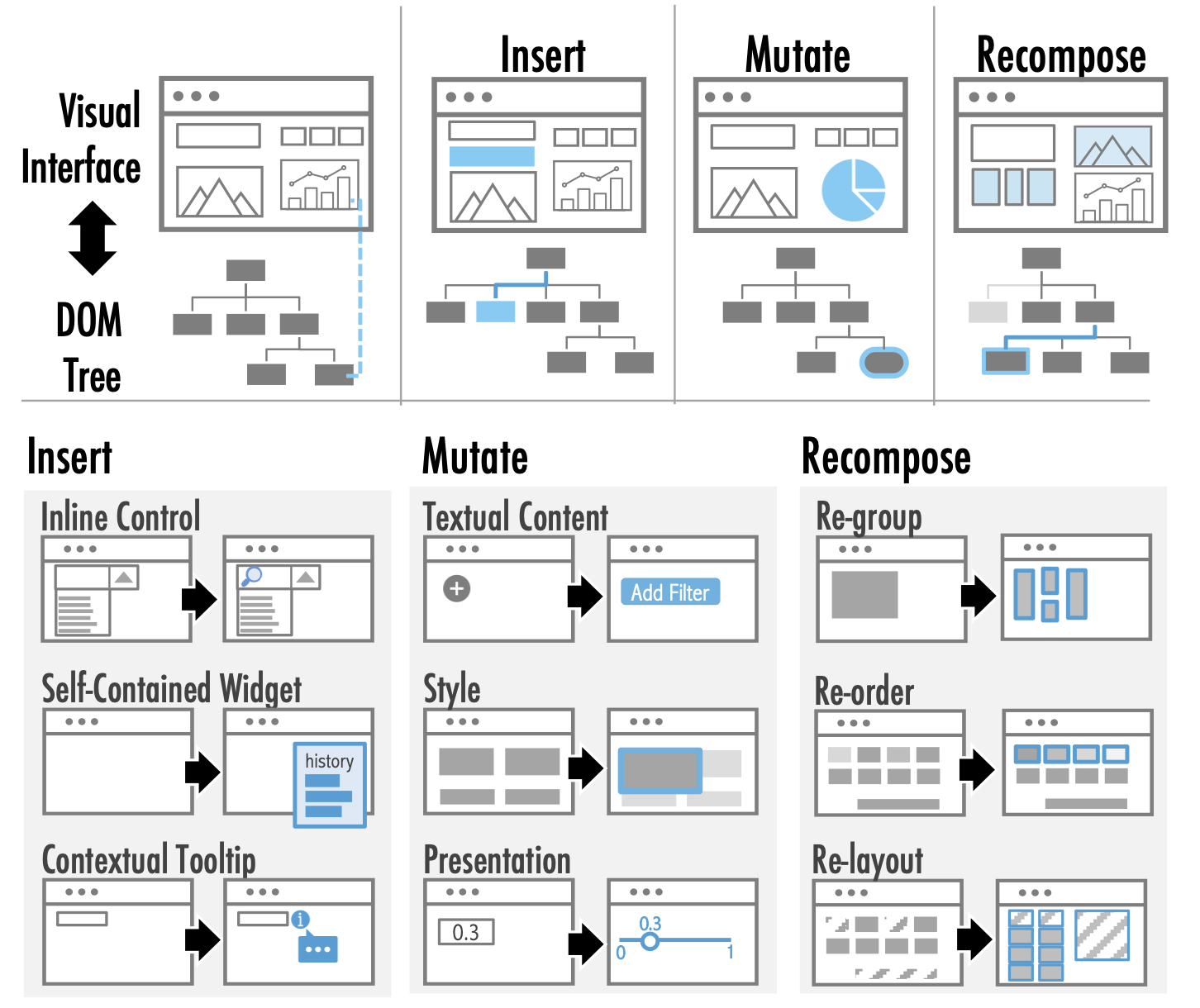
To address the gaps, we propose in-situ assistance: a mode of support delivered directly within any live web interface through lightweight, browser-level interventions on the Document Object Model (DOM), without rebuilding the application or modifying its underlying logic.
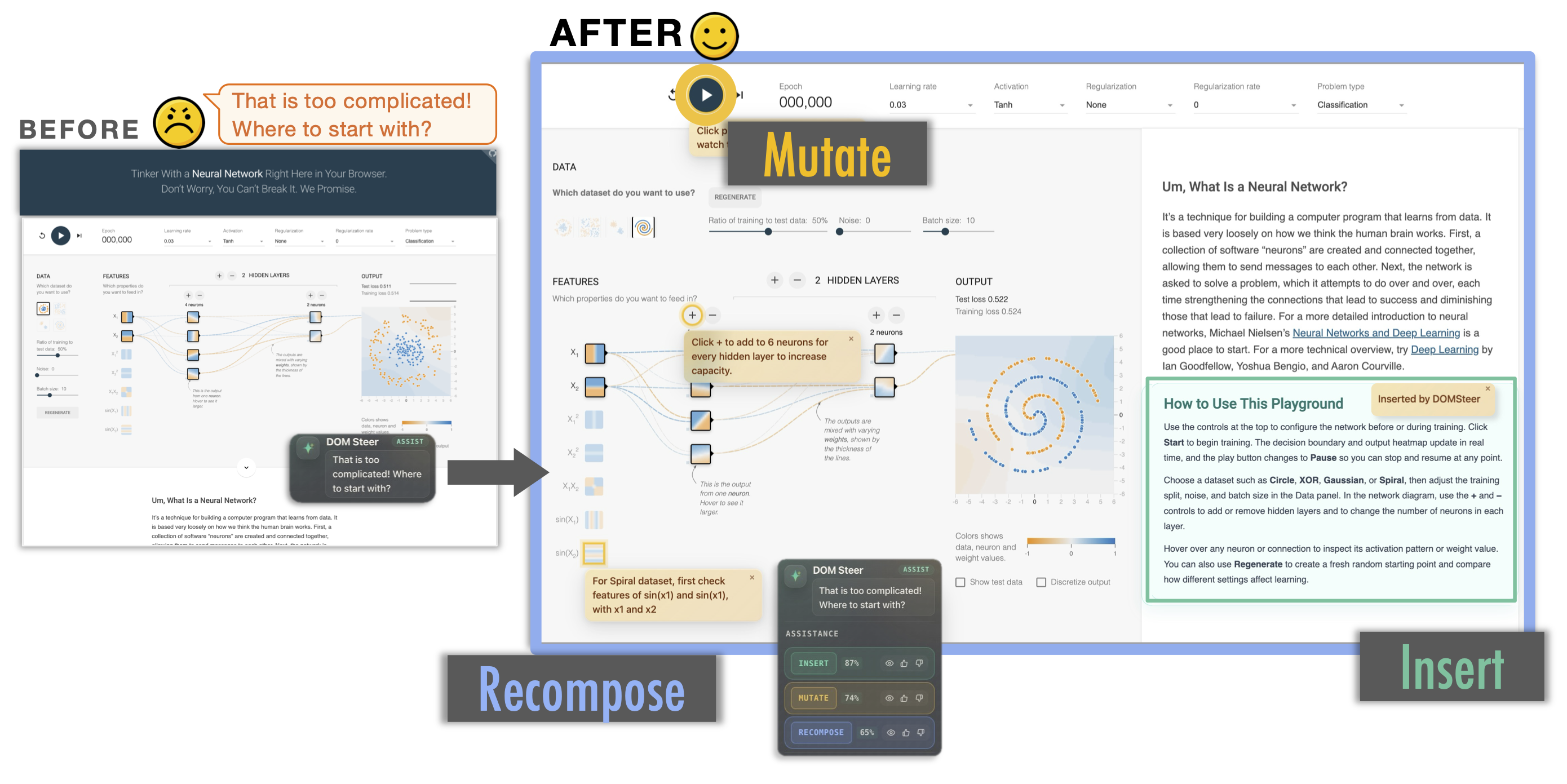
We explore GUI agent action space beyond chat and clicks. DOMSteer delivers in-situ assistance directly within the live interface through three DOM operations: (A) Mutate that adapts existing elements, (B) Insert that adds new contextual content, and (C) Recompose that reorganizes interface structure.
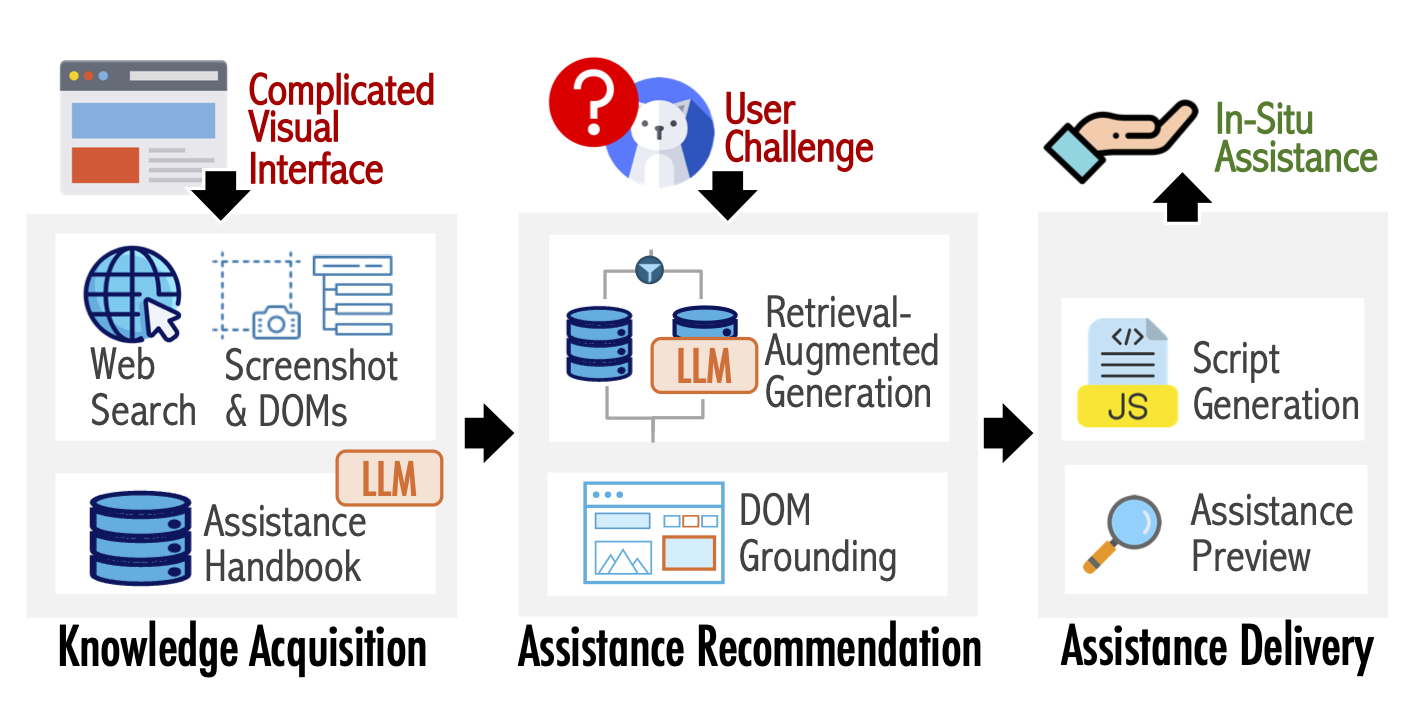
We contribute a design space and a computational pipeline for DOM-mediated in-situ assistance, characterizing how GUI agents can insert, mutate, or recompose web elements to make the interface easier for users to understand, use, and navigate. We instantiate in-situ assistance in DOMSteer, a Chrome extension that interprets a user's help request and live interface context, grounds it to relevant UI elements, and executes reversible DOM manipulations directly on the live page to deliver assistance, including contextual tooltips, control highlighting, layout reorganization.